











Casino Fairness Audits Explained
Ekim 30, 2026Lucky Dreams Casino – Wo jeder Spieler in Österreich geschätzt wird
Ekim 30, 2026Genuine Funds Betting Strategy for Cash or Crash Live Participants in UK

For UK participants in the high-risk game show Cash or Crash Live, a solid betting strategy is beyond just theory. It’s the foundation of responsible play. The game, with its virtual rocket and climbing multiplier that crashes at a unpredictable moment, puts to the test your nerve, timing, and planning. This guide goes beyond relying on luck. It lays out useful frameworks to control your money and choose when to cash out. We give UK players a clear, objective look at tactics made for this specific game. This is always framed by responsible gambling and the essential truth: the house always has its edge on every flight.
Money Management: The Core of Sustainable Play
If you remember one thing from this guide, let it be this: strict bankroll management is the key strategy for Cash or Crash Live. This means setting aside a specific amount of money you can afford to lose for gambling, then splitting it into session budgets and bet sizes. Without this foundation, even the smartest cash-out tricks will fail. A conservative method is most effective. Your standard bet should be a tiny slice of your total bankroll—think 1% or 2%. This protects you from the losing runs that will happen and lets you ride out the swings without depleting your bankroll in a few rounds.
Imagine you have a £100 monthly bankroll. Your bet per round might be just £1 cash or crash live experience £2. This discipline makes you see betting as a session activity, not a frantic chase to recover losses. We can’t stress this enough: set hard limits for wins and losses before you click play. Decide you’ll stop if you lose 20% of your session budget. Likewise, decide you’ll walk away if you hit a 50% profit. This structure removes emotional choices when the adrenaline is pumping. It’s the key to playing responsibly while aiming for real-money results over time.
Setting Loss Limits and Profit Targets
Pre-setting your exit points is a core part of managing your bankroll. A loss limit is the maximum you’re willing to drop in one session. When you hit it, you stop. No debate. A win goal is a realistic profit target where you’ll think about cashing out and ending the session. Make these goals relative to your session budget. Aiming for a 50% profit on a £20 session is sensible. Trying to double your money every time is a fast track to losing it all. Sticking to these pre-set limits is what separates strategic play from reckless gambling.
Risk Management: Hedging Techniques and Partial Withdrawals
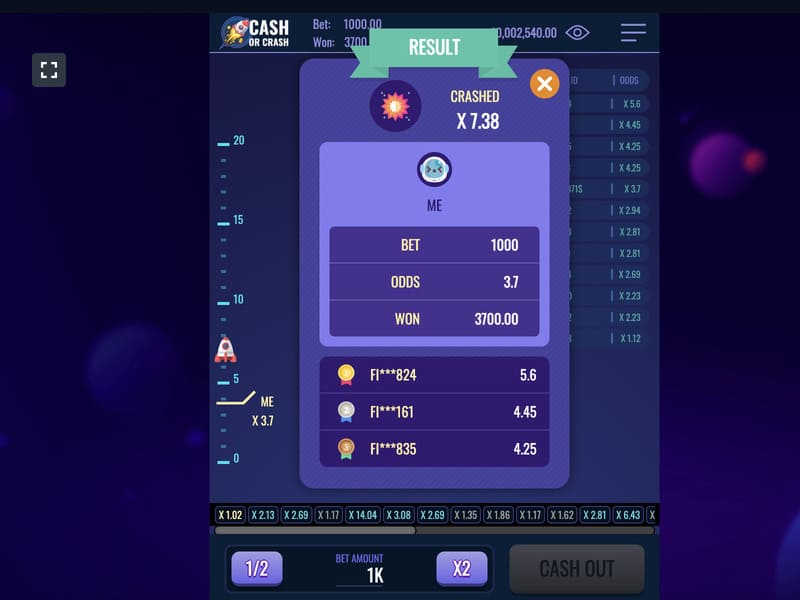
More advanced play in Cash or Crash Live involves techniques to handle risk during a single game. The game interface typically has a “partial cash-out” feature, a strong tool for the strategic player. This lets you cash out some of your original bet while keeping the rest to continue with the rocket. For example, with a £2 bet, you could cash out £1 at 2x (locking in a £1 profit) and have the other £1 ride risk-free. If the rocket then fails at 5x, you get an extra £4 from the second portion. If it explodes immediately after you cash out the first part, you recoup instead of giving up your entire stake.
Hedging strategies, by placing various bets, is an additional strategic technique. Some players make two bets at once: one with a cautious cash-out target and an additional with an bold target. This sets up a situation where you’re probable to gain some amount from the cautious wager, which can cover a loss on the aggressive one. If both win, the profit is substantial. While these methods don’t alter the fundamental odds, they offer a level of control. They enable you to secure profits and cut potential losses in the moment. This matches a disciplined, controlled approach for cash betting.
The Calculated Thinking: Chance vs. Human Behavior
Adopting the right mindset is a strategy in itself. You must accept the mathematical truth of Cash or Crash Live. Each game’s crash point is random and separate. The underlying algorithm fixes the chance that a crash will occur at or before any given multiplier. There’s no such thing as a “due” crash. A vehicle that just crashed at 2.00x is equally likely or unlikely to crash at 1.10x in the following round. This concept, known as event independence, confuses many players.. Chasing losses by upping your bet after a loss, or thinking a big multiplier is “overdue”, are blunders that can drain your funds rapidly.
Psychology matters just as much. The game is designed to generate excitement and that fear of missing out as the multiplier rises. A disciplined player learns to identify and control these emotional triggers. Your goal is to make choices based on the plan you set earlier, instead of reacting to the excitement or the live chat from other players. Developing a calm, almost detached view of each launch helps you follow your predetermined cash-out plan. You’ll resist being caught in the emotional highs and lows of the game show.
Adapting to Table Trends and Game Statistics
Even though each round is independent, watching table stats and short-term trends can inform your tactics. It need not determine them, nevertheless. The game screen typically shows the last few crash multipliers. A shrewd player might see if the table hasn’t seen a high multiplier (like anything above 10x) in the past 20 rounds. This does not create a high multiplier more likely next time. But it might persuade you to use a slightly more aggressive cash-out on one single bet, as a planned exception. View this as a small tactical shift within your overall plan, not a fundamental change of course.
Also, understanding the game’s theoretical Return to Player (RTP) and multiplier spread can be helpful. Different game providers may have slightly different volatility settings. Some games may be configured to produce more frequent but lower multipliers. Others could feature rarer but much higher crashes. Doing a bit of research or observation on your chosen Cash or Crash Live game’s profile can help you pick a strategy that matches. A high-volatility game works better with a conservative, frequent-cash-out plan. A lower-volatility game could enable you to aim for slightly higher targets without a massive jump in risk.
Comprehending the Fundamental Mechanics of Cash or Crash Live
You have to learn the game’s engine before building any strategy. Every round kicks off with a rocket launch. A multiplier starts at 1.00x and increases. The wildcard is the “crash point”—the exact multiplier where the rocket blows up. A random number generator sets this point the instant the round commences. That turns every game a distinct, unpredictable event. Players place their bets before the launch. To win, you have to cash out before the rocket crashes, boosting your stake by the cash-out value. If you’re too slow and the rocket crashes first, you give up your bet for that round.
The game’s tension arises from this basic tug-of-war. You wish the multiplier to climb for a bigger payout, but you risk losing everything if you wait too long. There’s no opponent to outsmart like in blackjack or poker. It’s just a random outcome and your own discipline. The live dealer adds a game-show feel, but they don’t change the maths. Recognizing that each decision is a fresh event ruled by probability is the first, and most crucial, strategic step for anyone playing with real money consistently.
Common Cash-Out Approaches and An Analysis of Them
Users of Crash-style games have devised several systematic cash-out methods. Let’s examine the most prevalent ones to assess their risks and upsides. Remember, no method can defeat the house edge over the long haul. But some can give your play a framework and assist control your risk. Your choice often hinges on your own appetite for risk and if you desire lots of modest wins or the rare bigger score. We’ll examine a few main approaches. Many users tweak or mix these ideas to suit their own style.
The Conservative (Fixed Multiplier) Tactic
This is the most straightforward, safest tactic. You choose a fixed, low multiplier target—say, 1.50x—and you cash out every individual time the rocket hits it. The advantage is reliability. You’ll guarantee a 50% profit on your stake often, accumulating your bankroll gradually and consistently. This method minimizes the times you get caught by a crash with no payout, since you’re not waiting for huge multipliers. The downside is obvious: you’ll forgo the massive payouts from rockets that go to 5x, 10x, or beyond. That can be frustrating. But for players who seek longer rounds and managed growth, it offers a clear, detached rulebook.
The Bold (Escalating Target) Strategy
Sitting at the other extreme, an risky strategy means letting the multiplier climb much higher before you cash out. A player could choose a first goal of 5x, then, after a few low wins, allow a bet ride to 10x. The big appeal is the opportunity for a major gain from one round. The danger is much higher, though. Numerous rockets will explode long before they attain those heights. This tactic can result to strings of losses followed by one large win. It demands a deep bankroll to withstand the swings and steely resolve, so it’s not a good match for most casual players.
The Paroli (Positive Progression) Adaptation

Taken from even-chance games like roulette, a Paroli system could be adjusted for Cash or Crash. The main concept is to raise your bet size after a win, seeking to capitalize on a “hot streak.” For example, after withdrawing at 2x, you might double your next bet. If you succeed again, you bank the profit and return to your starting bet. This can increase profits during a short stretch of successful cash-outs. The critical guideline is to begin again after a single loss or after a set number of wins (like three in a row). The risk comes if you neglect to reset. A loss after several increased bets can wipe out all your earlier gains.
Key Practices for the Strategic UK Player
Let’s bring together the strategic thinking with the practical side of playing for real money in the UK. This is a checklist of non-negotiable habits that reinforce everything we’ve talked about. First, only play at casinos licensed by the UK Gambling Commission that offer Cash or Crash Live. This provides fair play, proper RNG certification, and availability of responsible gambling tools. Use these tools—deposit limits, time-outs, self-exclusion—as part of your overall strategy. Second, view your gambling budget as money for entertainment, rather than an investment or a job. The main aim should be fun within what you can afford.
We recommend keeping a playing log to track how you’re doing. Write down your session bankroll, bets, strategies used, results, and final profit or loss. Looking over this log every so often can reveal patterns. You might see you drift from your plan when you’re tired or after a big win. Finally, never chase losses. If you hit your pre-set loss limit, stop. The game will still be there tomorrow. By blending mathematical understanding, psychological discipline, and these concrete steps, UK players can tackle Cash or Crash Live with a structured, strategic mindset. This maximises enjoyment while keeping play responsible.
- Only use funds you can afford to lose, strictly separated from essential finances.
- Establish and adhere to session time limits alongside monetary limits.
- Choose your cash-out strategy before playing and document any planned deviations.
- Incorporate regular breaks to avoid fatigue-induced decision-making.
- Use the partial cash-out function to actively manage in-round risk.
- Review your playing log monthly to assess strategy effectiveness and emotional discipline.
